





Now On Demand
Hedge Funds
The Hedge Funds session defines the portfolio role played by hedge funds, which offer higher long-term returns than investment-grade fixed income while diversifying the portfolio beyond equity and fixed income risks. Accepted for 1 CFP / IWI / CFA / CPA CE Credits.





About Us
Morgan Stanley Investment Management has been investing in private markets for over 40 years and is widely recognized as a pioneer in allocating across alternatives. We’re uniquely positioned to help financial advisors optimize client outcomes by integrating alternative and traditional investments within a thoughtful portfolio construction framework.
Why Invest in Alternatives
With new fund structures making private investments more available to accredited and mass affluent investors, increasing advisor education and knowledge on private market investing has become essential.

• Macro
• Equity Hedge
• Relative Value
• Event Driven
• Direct Lending
• Asset-based Finance
• Distressed Debt
• Mezzanine Lending
• Special Situations
• Venture Debt
• Buyout
• Growth
• Venture Capital
• Core
• Core Plus
• Value Add
• Core
• Core Plus
• Value Add
• Opportunistic


Source: Bloomberg, Morgan Stanley Wealth Management Global Investment Office, Private Equity Index Data: The Cambridge Associates Private Equity Index tracks the returns of a variety of private equity strategies, including buyout, control-oriented distressed, growth equity, energy, upstream energy and royalties, and venture capital. The data is updated quarterly using the Cambridge Associates Benchmark Calculator, with a lag of several months. Private equity returns are net to limited partners. Stocks are represented by the S&P 500 Total Return Index. Bonds are represented by Bloomberg US Aggregate. Alternatives Investments are composed of 16.6% Equity Hedge (HFRI Equity Hedge Index), 16.6% Equity Neutral (HFRI Equity Market Neutral Index), 33% Private Equity, and 33% Real Estate (National Council of Real Estate Investment Fiduciaries Property Index – NCREIF). Alternatives Investments are not suitable for all investors.
Past performance is no guarantee of future results. Estimates of future performance are based on assumptions that may not be realized. This material is not a solicitation of any offer to buy or sell any security or other financial instrument or to participate in any trading strategy. Please refer to important information, disclosures and qualifications at the end of this material.
Upcoming Classes
Class 13
Value Creation in Middle Market Private Equity
Tuesday, November 10, 2026 · 11:00am ET
The Value Creation in Middle Market Private Equity course explores why a differentiated, operationally-oriented approach is more important than ever for driving growth and creating value in middle market private equity, particularly during periods of high interest rates, inflation, and uncertain economic growth.
Learning Objectives:
- Understand why the middle market is an attractive investment opportunity and a compelling segment of the economy for private equity investing.
- Grasp why strategic focus, differentiation, and a hands-on approach are critical to creating value in today’s middle market private equity environment.
- Learn the core elements of the value creation process through real-world case studies that demonstrate how an operationally oriented approach can drive investment outcomes.
CREDITS
1
CFP / CFA / IWI / CPA
CE Credit
Class 14
Real Estate: 1031 Exchanges and Delaware Statutory Trusts (DSTs)
Tuesday, February 9, 2027 · 11:00am ET
Tax bills are one of the biggest obstacles investors face when considering a real estate sale. In this session, we explore the uses and benefits of 1031 Exchanges and Delaware Statutory Trusts (DSTs), which have become popular tools for helping investors to defer taxes and keep their equity working for them.
Learning Objectives:
- Understand how 1031 exchanges defer taxes by letting investors swap one investment property for another in a “like-kind” exchange.
- Learn the rules that govern 1031 exchanges, including the need for a qualified intermediary, the need for like-kind property, and the adherence to strict closing deadlines.
- Recognize the benefits and risks of DSTs, which let investors use gains from a real estate sale to become passive, fractional owners of a trust that owns real estate in a way that satisfies 1031 exchange requirements.
CREDITS
1
CFP / CFA / IWI / CPA
CE Credit
Class 15
A Deep Dive into Core and Value-Add Infrastructure Investing
Thursday, April 22, 2027 · 11:00am ET
This course provides a deep dive into infrastructure investing, examining how core and value-add strategies seek to generate returns across essential sectors such as transportation, energy, utilities, digital infrastructure and communications. Explore how different infrastructure opportunities can provide income, inflation protection and long-term growth potential within a diversified portfolio.
Learning Objectives:
- Understand the infrastructure opportunity set, including core and value-add investments across sectors.
- Identify the characteristics of core infrastructure assets, including stable cash flows, essential-service revenues, inflation linkage and modest leverage.
- Analyze the value-creation levers, including operational improvements, expansion and repositioning, used in value-add infrastructure investing.
- Recognize the role of infrastructure in a diversified portfolio, including the potential to provide income, inflation protection, diversification and long-term capital appreciation.
CREDITS
1
CFP / CFA / IWI / CPA
CE Credit
On Demand Classes
Class 1
Portfolio Construction & Asset Allocation
Now On Demand
The Portfolio Construction and Asset Allocation session discusses how portfolios can be built to reflect the specific characteristics and needs of each investor.
Learning Objectives:
- Define the characteristics of clients that shape their preferences for investments ranging from aggressive to moderate to conservative risk tolerance
- Discuss investor goals, including risk, return, inflation, taxes, downside protection, and thematic and tactical allocations
- Identify asset allocation methodologies, including capitalization-weighted global portfolios, scenario-based portfolios, risk parity, optimized quantitative portfolios, and the role of alternative investments
CREDITS
2
CFP / CFA / IWI
CE Credits
Class 2
Private Equity & Venture Capital
Now On Demand
The Private Equity and Venture Capital session discusses how the broad universe of PE and VC backed companies expand the investible universe beyond publicly traded companies.
Learning Objectives:
- Define the lifecycle of a private company and the investors who finance its growth at each stage
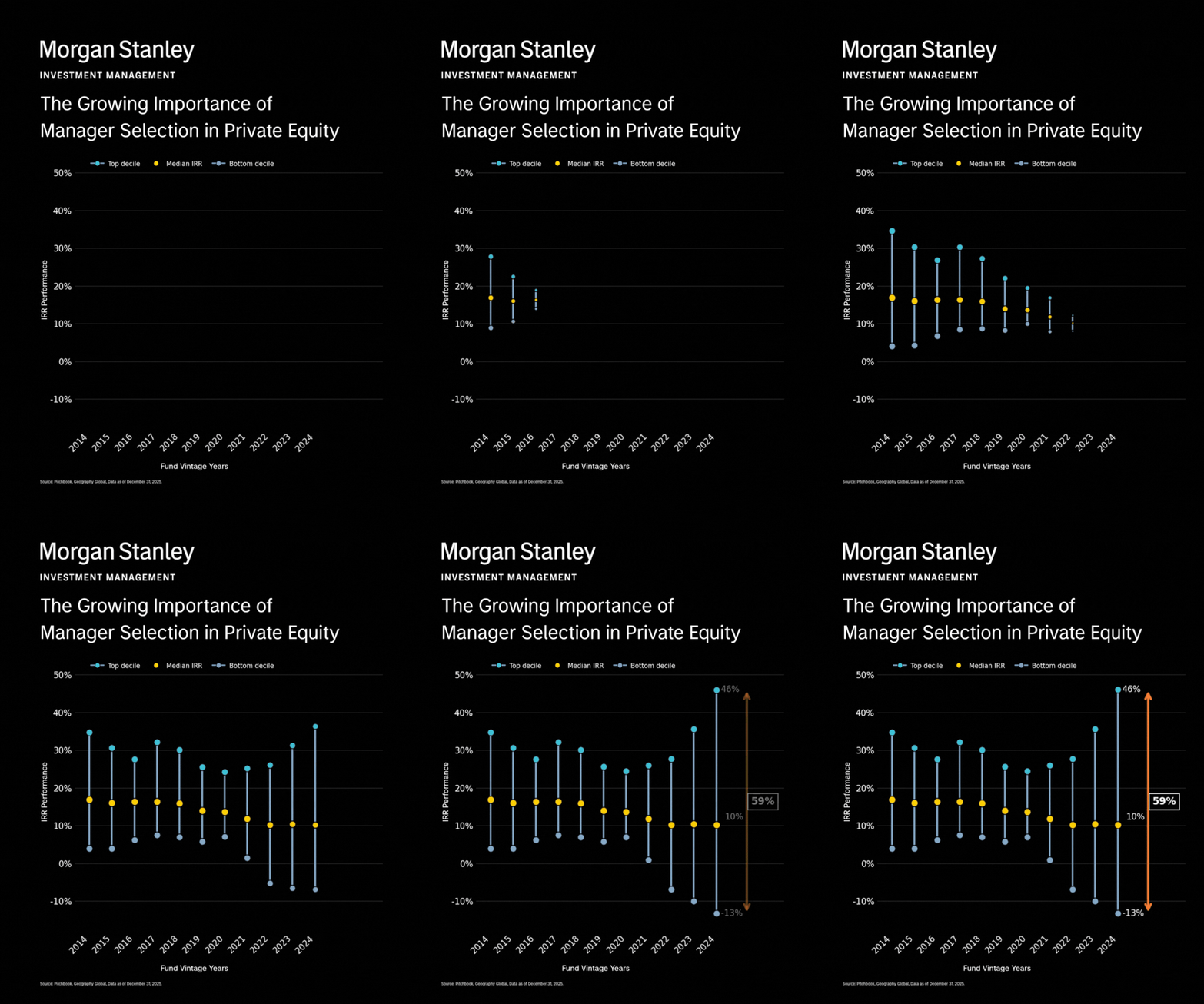
- Highlight key performance analysis for PE and VC funds, including internal rate of return (IRR), public market equivalent (PME), and multiple of invested capital (MOIC) metrics
- Discuss the liquidity implications of PE and VC investing, including committed capital, dry powder, capital calls, and exits
CREDITS
2
CFP / CFA / IWI
CE Credits
Class 3
Evergreen Private Equity: The Future or a Fad?
Now On Demand
The Evergreen Private Equity: The Future or a Fad session discusses why investors have increasingly embraced semi-liquid evergreen funds to access private equity investments.
Learning Objectives:
- Discuss the diversification benefits of a private equity allocation for individual investors
- Understand the difference between semi-liquid evergreen fund and a closed-end drawdown fund
- Explain the different roles private equity strategies play within an evergreen structure
CREDITS
1
CFP / CFA / IWI
CE Credit
Class 4
MSIM’s Approach to Allocating to Private Markets
Now On Demand
The MSIM’s Approach to Allocating to Private Markets session discusses our proprietary Private Markets Asset Allocation Framework (PMAAF), designed to help investors think about how to allocate their dry powder across private markets and cycles.
Learning Objectives:
- Understand the challenges investors face when building a private markets allocation
- Outline our approach to forming medium term signals across private markets asset classes
- Examples of views expressed in portfolio positioning
CREDITS
1
CFP / CFA / IWI
CE Credit
Class 5
Tax Forward Approach to Alternatives
Now On Demand
The Tax Forward Approach to Alternatives session explores integrating alternative investments into client portfolios to help maximize after-tax outcomes while aligning with clients’ investment objectives.
Learning Objectives:
- Explore the structure, mechanics, and tax benefits of Exchange Funds and how they can be used to diversify concentrated equity positions
- Analyze Long/Short Private Fund strategies with a focus on tax management to potentially generate tax-alpha
- Learn how REITs pass through the tax benefits of real estate ownership to individual investors in the form of tax-advantaged income
- Understand how insurance offerings such as private placement life insurance and private placement variable annuities can help clients achieve tax-advantaged growth
- Evaluate the different applications of these vehicles for different client profiles and portfolio objectives
CREDITS
1
CFP / CFA / IWI / CPA
CE Credit
Class 6
Real Estate & Infrastructure
Now On Demand
The Real Estate and Infrastructure session provides an overview of real asset investing, including real estate, infrastructure, farmland, timberland, and commodities.
Learning Objectives:
- Understand the opportunities presented by private and public investments in real estate, infrastructure, and other real assets
- Differentiate between the risk and return tradeoffs of core, core-plus, value-added, and opportunistic investments
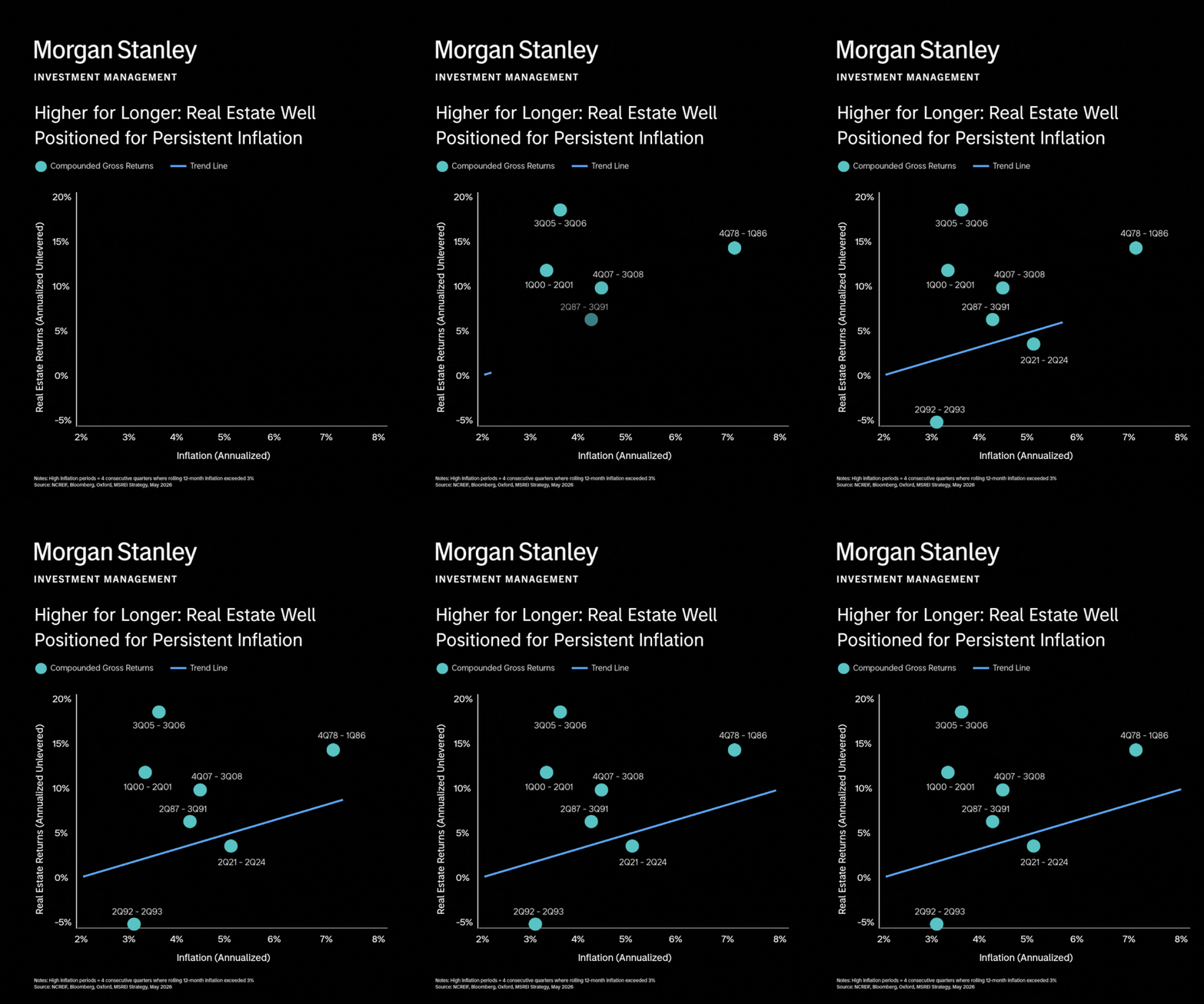
- Discuss the relationship between inflation and the returns to stocks, bonds, and real asset investments
CREDITS
2
CFP / CFA / IWI / CPA
CE Credits
Class 7
Deep Dive on Net Lease Investing
Now On Demand
The Deep Dive on Net Lease Investing session discusses why net lease investing has grown increasingly popular in recent years as an alternative approach to traditional real estate and fixed income investing.
Learning Objectives:
- Understand the characteristics and structure of net lease investments
- Explain the key risks and benefits of the net lease asset class
- Discuss net lease investments in today’s market environment
CREDITS
1
CFP / CFA / IWI / CPA
CE Credit
Class 8
Private Credit
Now On Demand
The Private Credit session compares investments in floating rate private credit loans and fixed rate public bond markets.
Learning Objectives:
- Understand the differences in risk and return by investing in public and private credit, as well as fixed and floating rate investments
- Discuss the range of private credit investments, including business development companies (BDCs), direct lending, mezzanine, distressed, specialty finance, real asset credit, bridge financing, and special situations
- List the risk, return, and liquidity characteristics of private credit, including the portfolio construction implications of funding allocations from equity, investment grade, and high yield debt
CREDITS
2
CFP / CFA / IWI / CPA
CE Credits
Class 9
Uncovering Direct Lending
Now On Demand
This course on Direct Lending uncovers how lending solutions are tailored for middle-market companies. Direct Lending has become the largest segment in the growing Private Credit market, and this course explains why.
Learning Objectives:
- Understand Direct Lending’s growing role in providing capital to middle market companies. This includes Direct Lending’s benefits and risks, such as higher interest rates and the negotiation of protective covenants.
- Learn the attributes of Direct Lending that motivate middle market companies to use this strategy for their capital needs, outside the syndicated loan market.
- Identify characteristics that make Direct Lending a worthy option for investors, including enhanced returns and downside risk mitigation.
CREDITS
1
CFP / CFA / IWI / CPA
CE Credit
Class 10
The Anatomy of Private Equity Co-Investing
Now On Demand
The Anatomy of Private Equity Co-Investing session explores the ability to make direct investments in companies alongside private equity sponsors, or general partners (GPs). Co-Investments can offer investors favorable terms by minimizing traditional management fees and carried interest.
Learning Objectives:
- Define and contextualize private equity co-investments and their significance in the market
- Understand why limited partners pursue co-investments and the potential benefits that come with the strategy
- Analyze why general partners offer co-investments and their role in private equity dealmaking
- Differentiate the approaches to co-investing and the pros and cons to each strategy
CREDITS
1
CFP / CFA / IWI / CPA
CE Credit
Class 11
Blending Private and Public Credit
Now On Demand
The Blending Private and Public Credit session discusses how public and private credit markets have evolved, why they are converging, and how investors can think about them more holistically in portfolio construction. The course reviews the growth of private credit, the expanding range of credit strategies available to borrowers and investors, and the potential benefits and risks of blended public/private credit approaches.
Learning Objectives:
- Understand the evolution of public and private credit markets and the major strategies within each.
- Explain why public and private credit markets are becoming more connected and how that affects borrowers and investors.
- Identify the potential benefits, risks, and implementation considerations of blended public/private credit strategies.
CREDITS
1
CFP / CFA / IWI / CPA
CE Credit
Class 12
Hedge Funds
Now On Demand
The Hedge Funds session defines the portfolio role played by hedge funds, which offer higher long-term returns than investment-grade fixed income while diversifying the portfolio beyond equity and fixed income risks.
Learning Objectives:
- Explain accredited investors, qualified purchasers, and the private placement exemption available to funds offered only to these high-net-worth investors
- Differentiate between Event Driven, Relative Value, Hedged Equity, and Macro and Managed Futures Strategies
- Define convergent and divergent hedge fund strategies and explain their implications for portfolio risk
CREDITS
1
CFP / CFA / IWI / CPA
CE Credit
Featured Insights From Morgan Stanley Thought Leaders
-

Asset Class Introduction: Hedge Fund Investing
Hedge funds can be difficult to generalize since they use a wide variety of strategies, including long-equity, macro and managed futures, relative value and event driven. Here, we give an overview of how each strategy works, the main risks and benefits, and how each strategy may fit within a portfolio.
-

Asset Class Introduction: Net Leasing
A Net Lease is a long-term, single-tenant lease where the tenant pays base rent plus some or most operating expenses like taxes, insurance, and maintenance. For investors, it offers predictable cash flows, appreciation potential, certain tax advantages and a potential hedge against inflation.
-

Asset Class Introduction: Private Credit
Private Credit consists mainly of six strategies: direct lending, asset-based finance, distressed debt, mezzanine lending, special situations and venture debt. Here, we provide an overview of how each strategy works, the key risks and benefits, and how each strategy could fit within a portfolio.
Alts Essentials
Alternative investments represent strategies that can deliver different sources of return than traditional stocks and bonds—making them important components of portfolio construction. These foundational videos provide a high-level overview of key segments within the alternatives universe.
-
 3:24
3:24 -
 3:24
3:24 -
 3:24
3:24 -
 8:00
8:00 -
 3:24
3:24 -
 3:24
3:24 -
 3:24
3:24 -
 3:24
3:24 -
 3:24
3:24




FEATURED
Morgan Stanley Investment Management Alternatives
We have been committed to managing alternative investment strategies since 1985. Today, we are a leading provider across private equity, private credit, hedge funds, real estate and infrastructure.